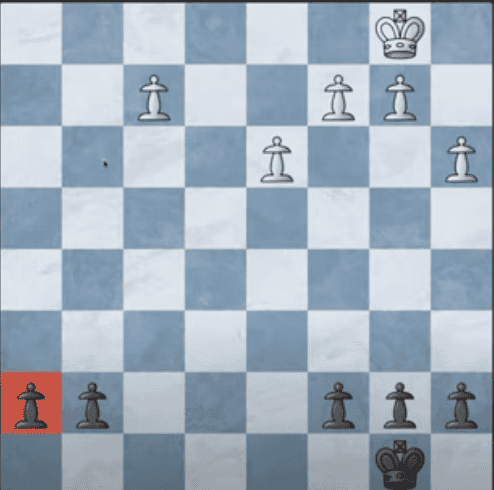
A passed pawn is a pawn that has successfully maneuvered beyond the opponent’s pawns, making it immune to being captured by them. Without adjacent pawns to obstruct its path, a passed pawn is likely to be promoted to a queen unless taken by the opponent’s pieces.
What is a Passed Pawn in Chess?
There are two primary categories of passed pawns:
- Unprotected Passed Pawns: In the intricate battlefield of the chessboard, an unprotected passed pawn, like the white pawn at ‘a’ in the diagram, relies on your pieces for defense against potential threats. A lack of support can weaken these pawns, rendering them vulnerable to capture. Skillfully position your pieces to ensure the opponent’s forces cannot impede the pawn’s progression;
- Protected Passed Pawns: The white pawn at ‘c,’ shielded by the white pawn at ‘d’ in the diagram, epitomizes the concept of a protected passed pawn. This defensive barrier augments its mobility and survival prospects. Black also boasts a passed pawn at b4, while the protected passed pawn at f3 faces opposition from the white knight.
In your matches, strive to create and fortify passed pawns while thwarting your opponent’s efforts. These pawns are invaluable and possess the capability to shift the game’s trajectory in your favor. Successfully advancing a passed pawn can lead to a triumphant progression, exerting intense pressure on the opponent.
Strategy and Implementation
Chess aficionados and novices alike recognize the insurmountable value encapsulated in these unassuming game pieces. They are not just pawns but silent warriors, charting an unobstructed path across the battlefield, poised for queen promotion. Each move, each strategic positioning, amplifies their latent power, transforming them into formidable forces that encapsulate the essence of unforeseen victory.
In the nuanced game of chess, the recognition, cultivation, and strategic deployment of passed pawns can orchestrate a narrative of triumph amidst impending defeat. These silent warriors, unheralded yet potent, encapsulate an unyielding power to transform the dynamics of a game, charting a silent trajectory from obscure pawns to potent queens, commanding respect and awe in the strategic battlefield of chess.
Harnessing the Power of Passed Pawns
In every chess player’s arsenal, the ability to adeptly maneuver and harness the latent power of passed pawns is a skill honed through strategic acumen and experiential wisdom. These pawns, seemingly innocuous, morph into potent forces of victory, charting silent paths of triumph in the intricate battlefield of chess.
A player’s ability to identify, nurture, and strategically deploy passed pawns can be the defining factor separating victory from defeat. In the silent yet tumultuous battlefield of chess, where every move is a silent narrative echoing strategic wisdom, passed pawns emerge as silent testimonies of triumph, weaving narratives of victory amidst the impending specter of defeat.
As silent narratives of strategic acumen and unforeseen victory unfold on the chessboard, remember, the silent, unheralded march of a passed pawn could very well be the clarion call heralding an impending, resounding triumph.
Conclusion
The ability to identify and utilize passed pawns is a hallmark of a seasoned chess player. They pave the route to victory and should be cultivated with strategic precision. Passed pawns might appear inconspicuous, but their potential for board domination is undeniable. Remember, on the chessboard, the trajectory of a passed pawn could very well chart your path to victory.
In the complex dynamics of chess, mastering the utilization of passed pawns elevates a player’s game from ordinary to exceptional. These unobstructed pawns, unimpeded by the opposing side’s infantry, are powerful assets. They morph from seemingly inconspicuous game elements into potent tools capable of altering the game’s landscape, transforming imminent defeat into a resounding victory.