The Ruy Lopez, also known as the Spanish Opening or Spanish Game, holds a place of considerable favor within the chess community and frequently graces the boards of prestigious high-level chess tournaments. Notably, the Closed Ruy Lopez stands out as a widely employed variation within the broader Ruy Lopez Opening. This variation is characterized by a clever tactical maneuver where the bishop strategically retreats to a4 in response to the challenge posed by a6. Consequently, it has become the favored choice among ardent chess enthusiasts.
In the forthcoming discussion, we shall embark on an exploration of the intricacies inherent to the Ruy Lopez. Our journey will involve shedding light on its rich historical significance, unraveling the strategic subtleties that underlie its gameplay, and highlighting the enduring prominence of the Closed Ruy Lopez. This variation remains a stalwart selection for chess players aspiring to establish a formidable positional advantage on the chessboard.
The Evolution of the Bishop’s Position in the Ruy Lopez
Opening Moves and White’s Strategic Decision
Within the intricate domain of chess, the Ruy Lopez opening gracefully unfurls its strategy through the sequence of moves commencing with 1.e4 e5 2.Nf3 Nc6 3.Bb5. This timeless chess gambit has withstood the test of time, enduring across countless centuries as a revered and reliable choice for players seeking an advantageous start.
As the game’s narrative unfolds, Black often confronts White’s strategic placement of the bishop by executing the tactical move 3…a6. In this pivotal moment, White is presented with a consequential decision, one that may significantly shape the ensuing skirmish. A fascinating divergence in the game’s trajectory materializes when White, with the intention of preserving the coveted advantage of dual bishops, elegantly repositions the bishop with 4.Ba4.
This shrewd maneuver endows White with the invaluable asset of maintaining the dual flexibility of both bishops. Such dexterity in the utilization of these bishops proves particularly advantageous, especially when navigating through the dynamic intricacies of open positions on the chessboard.
Black’s Countermoves
In response, Black, now aware of the potential pin on the knight (also termed the queen’s knight), has an opportunity to break free by advancing the pawn with …b5. This often prompts White’s bishop to shift even further, usually landing on c2. From this square, the bishop plays a vital role in bolstering the defense of the e4 pawn, turning it into a crucial pivot for the unfolding middle game.
Alternatives and Considerations for White
Yet, 4.Ba4 isn’t the only card White can play. A bolder choice involves exchanging the bishop for Black’s knight. This strategic sacrifice lets White dent Black’s pawn configuration. But every decision has its consequences. By opting for the trade, White relinquishes the coveted two-bishop advantage.
Black’s Gains from the Exchange
While White gains some initiative with this trade, Black isn’t left bereft. The silver lining for Black is gaining the two-bishop advantage, which can be leveraged in subsequent moves. It’s essential to understand that Black invariably finds compensation across various lines, ensuring a balanced struggle on the board.
Deep Dive into Masterful Games of Ruy Lopez
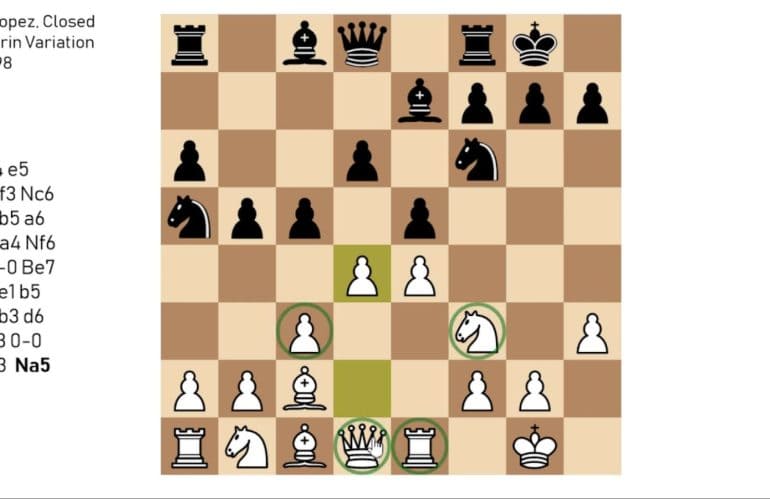
For those keen to delve deeper, examining the games of the Closed Ruy Lopez offers a wealth of strategic insights. Especially noteworthy are the games played by the élite of the chess world: those grandmasters who have surpassed the 2700 ELO mark. Often referred to as “Super Grandmasters” or “Super-GMs”, their matches in this opening offer invaluable lessons.
Conclusion
The Ruy Lopez, a storied chess opening, is a testament to the intricate dance of strategy and counter-strategy that defines the game of kings. White’s decision to either retreat the bishop or trade it off presents a complex web of possibilities, each with its own pros and cons. Black’s ability to adapt and counter, highlighting the dynamic nature of the game, underscores that in chess, as in life, every move has consequences. The games of the Super Grandmasters in the Closed Ruy Lopez serve as a masterclass, illuminating the depth and beauty of this ancient opening. For enthusiasts and professionals alike, the Ruy Lopez remains an evergreen study in strategy, adaptation, and the fine balance of power on the chessboard.