Take a moment to revisit and peruse the remarks associated with the game below. This marks your inaugural foray into the world of gaming, and it’s imperative that you initiate the game with the same opening chess moves, whether you choose to play as White or Black. If your adversary opts for a different course of action, so be it; one must commence somewhere, after all.
For those who are new to the realm of chess, it’s advisable to commence your journey by executing the move 1.e4. This particular move sets the stage for open and strategically dynamic encounters, enabling you to grasp the fundamental tenets of chess more rapidly than when contending in locked, unyielding positions. Venturing into the realm of 1.d4 or 1.c4, which typically leads to closed and positional games, is a venture best reserved for when you have honed your skills further.
The Power of 1. e4: Mastering the Central Domination
The game of chess begins with players making their opening moves, and one of the most popular and effective openings is 1. e4. When a player decides to initiate with this move, they are making a calculated decision to command the center of the board and prepare for the subsequent development of their pieces. Let’s delve deeper into the strategic elements of this opening and the ideal follow-up moves to maximize its advantages.
1. Central Control with 1. e4
- Objective: By moving the pawn to e4, a player seeks to control the pivotal central squares d5 and f5. Dominating the center early in the game provides a strong foundation and can dictate the course of the game;
- Benefit: Controlling these squares restricts the opponent’s piece movement and provides more options for one’s own pieces to maneuver.
2. Unleashing the Kingside Bishop
- Key Locations: With the e-pawn moved, the path is cleared for the kingside bishop situated on f1. This bishop has two prime destinations;
- Bishop to c4: A direct approach that targets the vulnerable f7 pawn in black’s camp;
- Bishop to b5 (The Spanish Game): A more subtle approach, pressurizing the knight on c6 and creating potential for various tactical themes;
- Tip: Before deploying the bishop, prioritize developing the kingside knight.
3. Prioritizing the Kingside Knight
- Natural Destination: The ideal square for the kingside knight is f3. From this position, it exerts pressure on black’s central e5 pawn, posing an immediate threat and asking questions of black’s defense;
- Why Knight First?: The adage “Knights before Bishops” isn’t just tradition—it’s strategic;
- Knights: A knight on its starting square, like g1, is limited in its influence. It doesn’t control any significant squares and is often likened to a dormant entity. Thus, activating the knight early is crucial;
- Bishops: Even on their starting squares, bishops have a broader range of motion, especially once pawns are moved out of their path. For instance, once the e-pawn advances, the f1 bishop already has a clear diagonal.
Golden Rule for Development
- Knights First: Accelerate the knights from their starting squares to enhance their influence;
- Bishops Next: With the knights activated, unfold the bishops to maximize their reach and control;
- Insight: Remember that the efficiency of a piece isn’t just about its position but also about the squares it controls and influences. A well-placed knight or bishop can dictate the tempo of the game, restricting the opponent’s options and creating opportunities for tactical blows.
Understanding the Strategic Depth of Nc3 in Chess
1. The Nc3 Maneuver: An Overview
White’s decision to play c3 in a given game is often about dominating the d4 square. In a contrasting strategy, however, White may opt for the direct Nc3 move. Here’s a deeper dive into these choices:
- Purpose of c3: It serves as a reinforcement for the d4 pawn;
- The straightforward Nc3: Here, White immediately aims to influence the center and apply pressure.
2. Guarding the Vital Bishop on c4
The position on the board often makes White’s bishop on c4 a prized piece, especially in half-open games. Black will, at times, eye this piece for a trade with the move Na5. A few key insights:
- The potency of the bishop: In these positions, the bishop wields more power than its knight counterpart;
- Preventing Na5: White must be proactive, and a3 is the ideal move. This gives the bishop an escape route to a2 when threatened by Na5. Thus, Ba2 keeps the bishop dominant on the a2-g8 diagonal.
3. Analyzing the Dynamics around the Bishop and Knight
There are intricate dynamics between the bishop at c4 and Black’s knight on c6:
- Initial scenario: With the black knight on c6, any Na5 move is ill-advised, as White’s Nxe5 move would snatch a pawn;
- The d6 change: Once Black plays d6, the pawn gains protection, and the Na5 move becomes a genuine threat. White can counter this with a3, providing a haven for the bishop at a2.
4. Addressing the Knight’s Pin
The placement of the white bishop, external to its pawn chain, leaves the knight on f3 vulnerable. Black can exploit this:
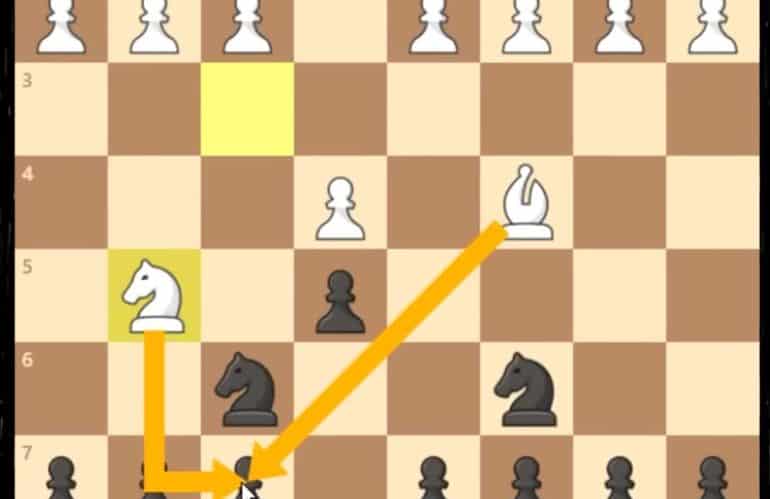
- The pin: Black’s Bg4 puts the knight in a bind, setting up for the potential Nd4, intensifying the pressure;
- White’s counter: A knee-jerk g4? is not recommended as it jeopardizes the kingside pawn structure. A better approach is Be3, which permits trading knights if Nd4 is played.
5. Evolution of the Game with the Bishop-Knight Exchange
As the game progresses, the exchange of pieces and pawn structures influences the dynamics:
- Trade dynamics: After the white bishop trades for Black’s d4 knight, the board takes on a more stagnant character. In such a scenario, knights hold their ground against bishops;
- The stifled black bishop: Black’s e7 bishop is restricted by its own d4 pawn. This inherent blockade diminishes its power and mobility.
6. White Knight’s Repositioning Strategy
Facing threats from the d4 pawn, White’s knight must retrace its steps:
- The route: The knight seeks refuge by first relocating to b1, and subsequently to d2. This not only fortifies the f3 knight but also paves the way for potential plays on the kingside;
- King’s safety: With no direct threats or open lines for Black, the white king remains in a secure position.
Chess is a game of intricate strategies and foresight. Understanding maneuvers like Nc3 and the dynamics they introduce can greatly elevate a player’s game. Adopting proactive measures, safeguarding vital pieces, and comprehending the evolving nature of the board are essential skills to master.
Conclusion
In conclusion, selecting the best first chess move is a crucial decision that sets the tone for the entire game. While there is no one-size-fits-all answer to this question, as chess is a complex and dynamic game, we have explored some of the most popular and effective opening moves in this article.
Ultimately, the best first move in chess depends on your playing style, your opponent’s strengths and weaknesses, and your overall strategy for the game. It’s important to remember that chess is a game of skill, strategy, and adaptation. As you gain experience and knowledge, you’ll develop a better understanding of the openings that suit your style and objectives.